Curriculum (Re)design
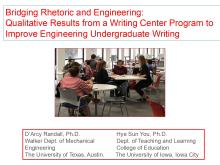
Bridging Rhetoric and Engineering (IPCC)
“Bridging Rhetoric and Engineering: Qualitative Results from a Writing Center Program to Improve Engineering Undergraduate Writing,” Proceedings from IEEE ProComm, 2024. Pittsburgh, PA (July 14-17, 2024). I delivered this co-authored conference paper at the IEEE ProComm conference. See the link for the paper.
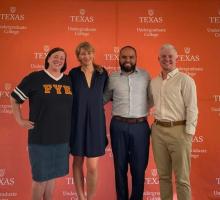
Be Well to Do Well (Signature Course Resource)
This video project was designed to be shown in all Signature Courses at UT. Together with a discussion prompt, the video aims to acquaint students with mental and physical health resources on campus, and to teach them strategies for success.
Does Increasing Course Depth While Reducing Breadth Improve Learning in College Students?
Student-centered learning strategies have been effectively used to increase academic performance and learning in students. Educators have hypothesized that course content reduction can also improve student learning. However, support for this idea is lacking. In the present project, I am planning to assess whether a content reduction strategy increases the academic performance of upper-division stem students at the University of Texas-Austin.
Artful Learning: Integrating Art into Teaching Practice
This project aims to transform academic instruction by integrating art into the classroom. We believe that art can make subjects more engaging and help students connect with the material on a deeper level. By integrating diverse forms of art—such as virtual art, music, film, theater, and more—into the curriculum, we aim to create a more interactive and stimulating learning environment while also supporting students' mental health through therapeutic art sessions.
Implementing Computational Modules into the Materials Science and Engineering Undergraduate and Graduate Curricula
The development of increasingly powerful computational resources has made computational competencies new core forms of literacy that should be formed as part of basic education across all STEM fields.
QR Learning for addressing social and racial injustice
The current proposal envisions developing alternative pedagogical materials for the “Measuring Racial Inequality” course, written in plain language and accessible to students from social sciences/humanities and underserved communities and families.
Compassionate Pedagogy and Experiential Learning
The primary goal of this project is to enhance student engagement and participation in the learning environment, especially those who have may have been marginalized by conventional approaches to teaching. This project aims to support, encourage, and train faculty to incorporate compassionate pedagogy (CP) and experiential learning (EL) into their teaching, with the goal of promoting student connection and faculty creativity.
Early Exposure to Data Skills in Introductory Biology Sequence
Biology continues to be seen as a field for science-interested, but math-disinterested students. However, due to the surge in data use in all biology careers, and the focus in research on sequence data, there is a strong need for data skill development in biology degree programs. Math anxiety poses a specific challenge for biology education. A suggestion to overcome this, is an early introduction to data skills in the two-course sequence of Introductory Biology.
Offering Real-World Opportunities for Students Enrolled in Statistics and Data Science Undergraduate Research
The primary goal of this community-based service project is to provide experiential learning opportunities for undergraduates interested in statistics and data sciences while supporting the broader Austin-area community. Coordinating with local organizations, students enrolled in some of our SDS courses are gaining hands-on experience in data analysis while exploring authentic contexts. This innovative and collaborative effort provides a community-based model that allows students and local organizations to co-develop and answer real-world research questions.
Strengthening the Sustainability Studies Degree
Sustainability Studies graduated its first sizeable cohort in 2022, and the program has yet to undergo a comprehensive review. Conversations with students revealed their desire for better access to the professional field of sustainability across the sectors of non-profit, government, and business. This is an area that the current structure of the degree does not adequately address. To address these concerns, I am proposing a three-pronged approach. My first initiative is to build a database of internships across the three sectors mentioned above.